
Introduction to your assessment
Our Staff
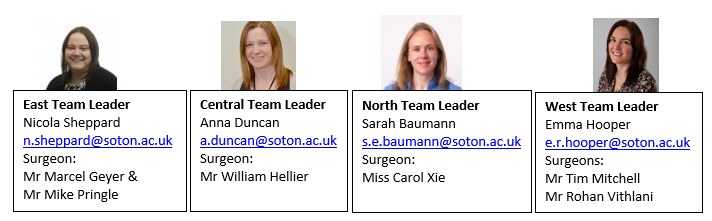
USAIS is made up of 4 teams based on where you live, (East, Central, North or West), each has a Team Leader who will be the main point of contact and at least one Surgeon.
 The assessment process is for the team to work out if a cochlear implant is likely to give you better access to sound than your hearing aid/s do. It is also a good time for you to ask more about how it works and what it can offer you so that you are able to decide if a cochlear implant is what you want. Each team will also include:
Who can have a Cochlear Implant?
- If your hearing loss meets the NICE guidelines for a Cochlear Implant
- If you are medically fit for surgery
- The team feels you will benefit from a Cochlear Implant
The NHS provides funding for adults to have one cochlear implant (two if you have a Certificate of Visual Impairment).
What benefit can a Cochlear Implant give?
It is difficult to predict outcomes exactly, but we will tell you if we do not think an implant will give you better hearing than you already have. With a cochlear implant average aided levels are usually between 20-40dB across speech frequencies. Ability to hear environmental sounds and hear and understand speech is largely based on hearing history.
Appointments
We use the following hospitals for cochlear implant surgery (you will not be able to choose which hospital to go to):
If you have a medical condition that could potentially require more support at the operation, then you will go to an NHS hospital for surgery. You may not have surgery with the Consultant allocated to your team.
Assessment Appointments
All patients will receive the following assessment appointments, at AIS, unless told otherwise:
- Initial audiology
- Assessment process counselling
- Medical appointment
- Communication assessment
- CT/MRI scan (this will take place at the hospital, usually Southampton General Hospital)
- Expectations and device choice
Some patients will also be invited for:
- Repeat audiology
- Balance assessment
- Tinnitus counselling
- Psychology
There may be more than one appointment a day to keep the number of visits down.
Around the time of the operation
- Anaesthetic check (at the hospital that you will be attending for surgery)
- Pre-operation medical at AIS
- Operation (at the hospital, usually with one night stay)
- Post-operation medical at AIS and Introduction to Speech Kit Processor at AIS (approximately 10 days after the operation)
Tuning of the speech processor
A typical programme for tuning the speech processor is:
- Initial tuning appointment (approximately 3-4 weeks following surgery)
- 1 week appointment
- 1 month appointment
- 3 months appointment
- 12 months appointment
- Yearly questionnaire/remote check and appointment if needed
- Five-yearly upgrade to the latest processor
These appointments may change, and you may be offered more/fewer appointments. Most audiology appointments are followed by a communication support appointment with a hearing therapist or a speech and language therapist. It may be possible to carry out some audiology checks and changes remotely, to save you travelling to Southampton as much. However, this depends on a number of factors, such as the implant manufacturer you have, your clinical needs and having a compatible mobile phone etc.
Balance
Some patients experience a disruption to their balance after surgery. If we feel you are particularly at risk, we will arrange a balance assessment as part of our assessment. If you do experience balance difficulties these will usually resolve after a short time. We have a balance specialist who can assess and provide rehab exercises if there are any ongoing issues. Please let us know if you wish to discuss balance further.
Tinnitus
- Most cochlear implant patients experience a reduction in tinnitus after speech processor fitting
- Some cochlear implant patients experience a temporary increase in tinnitus between cochlear implant surgery and speech processor fitting (usually about 3-4 weeks)
- Tinnitus can be exacerbated in a small number of cochlear implant patients. We will be able to arrange appointments to help you deal with any tinnitus that you experience
- Do ask a member of staff if you wish to discuss tinnitus and cochlear implantation further
Links to financial support
Healthcare Travel Costs Scheme (HTCS) nhs.uk/nhs-services/help-with-health-costs
Disabled Living Allowance (DLA) www.gov.uk/dla
Personal Independence Payment (PIP) www.gov.uk/pip
Armed Forces Compensation www.gov.uk/guidance/armed-forces-compensation
The links are also available on the USAIS Website
https://ais.southampton.ac.uk/financial-support/
Self-funded Cochlear Implants
We recognise that the NHS NICE criteria are strict when compared to criteria around the world and that there are adults who could benefit from cochlear implantation but are not eligible for NHS funding.
Our self-funded service has been suspended for the time being but if you would like to know more about this, please speak to your clinician or Team Lead for more information.
Please remember that if at any time of the assessment process you do not feel that an implant is what you want then let us know.
If you have any questions let us know. We are here to help you.